
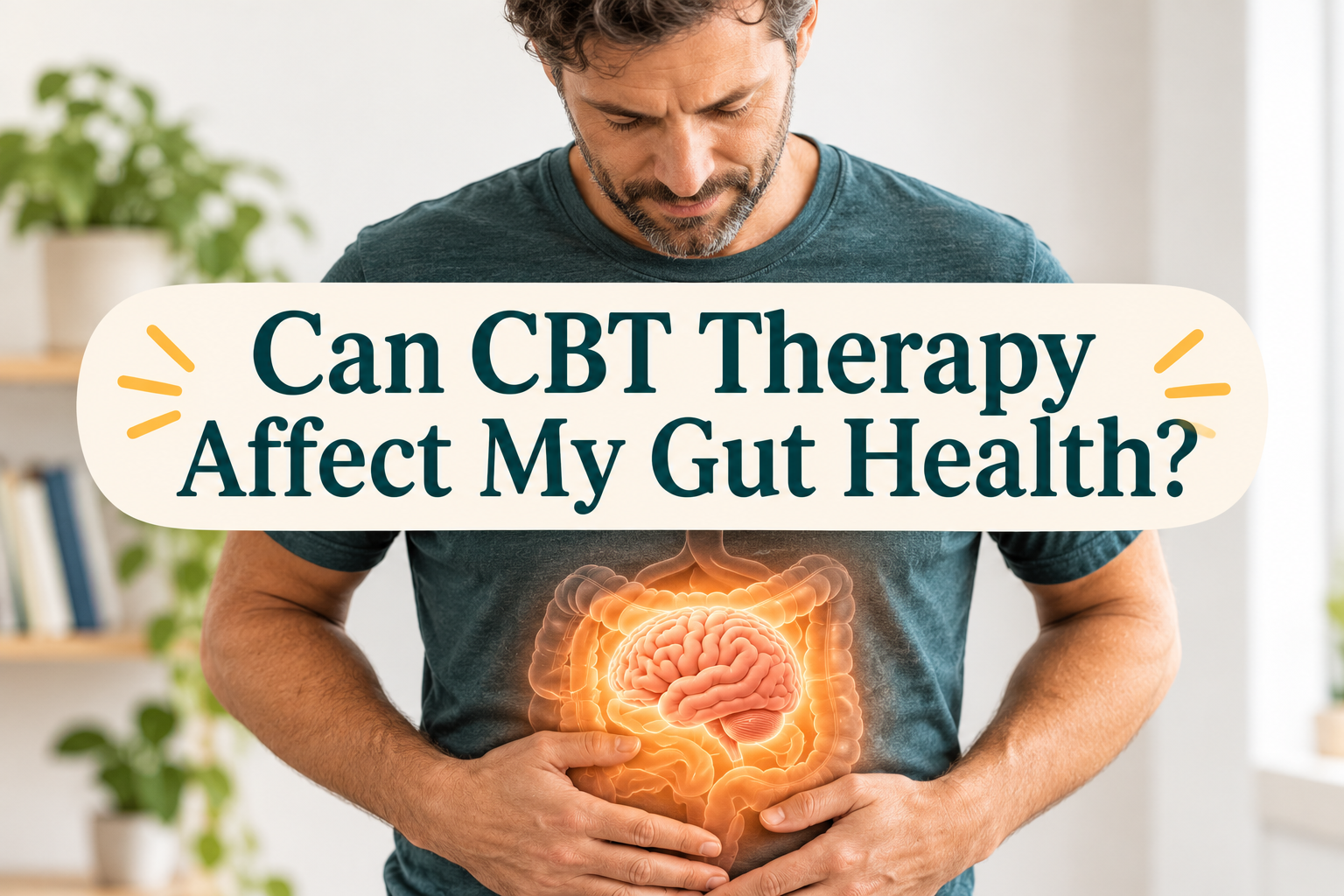
Yes, for many people. Cognitive behavioural therapy (CBT) is one of the most studied treatments for irritable bowel syndrome (IBS), and dozens of randomized trials show it can ease pain, bloating, urgency and the worry that comes with them. Canadian gastroenterologists now suggest CBT as part of IBS care. For inflammatory bowel disease, such as Crohn’s disease or ulcerative colitis, CBT helps people cope and feel better day to day, but it hasn’t been shown to change the disease itself.
If you’ve ever had a nervous stomach before something like a job interview, you already know the gut and mind talk to each other. Below, we walk through what the research says, why therapy can calm a sensitive gut, and how to start CBT with Strength in Heart Counselling in Victoria, in Mill Bay or online.
The gut-brain connection: how stress affects your gut
Your gut has its own network of roughly 100–500 million nerve cells, the enteric nervous system, and it stays in constant contact with the brain through the vagus nerve, the spinal cord, stress hormones and immune signals. Messages travel both ways. A sore, crampy gut can make you anxious, and stress can speed up or slow down how food moves through you, change how sensitive the gut lining feels, and shift what your brain registers as pain.
This two-way traffic is why doctors now group IBS and similar conditions under the name “disorders of gut-brain interaction.” The Rome Foundation, the international body that sets the diagnostic criteria for these conditions, calls the talk therapies that target this loop “brain-gut behaviour therapies.” CBT is the most studied of them, alongside gut-directed hypnotherapy.
What the research says about CBT for IBS
IBS affects about 1 in 10 people, and it’s where nearly all the good CBT evidence comes from. Three bodies of research stand out.
The big-picture review. In 2020, a team led by Christopher Black and Alexander Ford pooled 41 randomized trials with 4,072 adults with IBS in the journal Gut. Face-to-face CBT, self-guided or minimal-contact CBT, and gut-directed hypnotherapy had the most trials behind them. People who did CBT were roughly 40% less likely to still have significant symptoms at the end of treatment than people in the comparison groups. The authors also flagged that many trials carried a high risk of bias, so the true benefit is probably somewhat smaller than the pooled numbers suggest.
A large trial of brief, mostly at-home CBT. The U.S. IBS Outcome Study, published in Gastroenterology in 2018, randomized 436 people with moderate to severe IBS. Two weeks after treatment ended, 61% of people who had four CBT sessions plus home-study materials reported their symptoms were moderately or substantially better, compared with 55% after ten weekly clinic sessions and 43% after education alone. The four-session version held up at six months, which matters for anyone who can’t commit to weekly appointments.
61%
improved with 4 sessions of mostly at-home CBT
55%
improved with 10 weekly clinic CBT sessions
43%
improved with education alone
A long-term trial with phone and online CBT. The UK’s ACTIB trial randomized 558 adults whose IBS hadn’t improved with first-line treatments to telephone CBT, web-based CBT with a little therapist support, or usual care. Both CBT groups did better at 12 months. At 24 months, about 71% of the phone-CBT group and 63% of the web-CBT group had a clinically meaningful drop in symptom scores, compared with 46% of the usual-care group. Fewer than 6 in 10 participants were still being followed by then, so these later numbers are less certain.
Canadian gastroenterologists have folded this into practice. The Canadian Association of Gastroenterology’s 2019 IBS guideline suggests offering CBT to people with IBS to improve their symptoms, alongside gut-directed hypnotherapy, diet changes and medication.
How CBT helps gut symptoms
Researchers still don’t fully know how CBT works for IBS, but a few explanations have support.
The first is fear of gut symptoms. Many people with IBS start scanning their body for the next cramp, mapping every bathroom on the route, or skipping meals before going out. That vigilance keeps the stress system switched on, and a gut that is already oversensitive registers ordinary digestion as pain. A 2018 analysis by Hugo Hesser, Brjánn Ljótsson and colleagues in Sweden found that reductions in this gut-specific anxiety were one of the routes through which their online exposure-based CBT reduced avoidance and symptoms.
The second is how the brain processes gut signals. In a 2021 study in Microbiome, Jonathan Jacobs, Jeffrey Lackner, Emeran Mayer and colleagues scanned the brains of 84 people with IBS before and after CBT. People who improved showed changes in brain networks involved in attention to body sensations and pain, and those brain changes lined up with shifts in their gut bacteria.
That microbiome finding is the closest the research gets to CBT changing “gut health” in a physical sense. It’s an early result. Everyone in that study received CBT, so there was no comparison group, and the authors couldn’t say whether the brain was changing the gut bacteria or the other way around. No one should start CBT expecting it to remodel their microbiome.
What CBT for IBS and gut symptoms looks like
Gut-focused CBT is practical and skills-based. The version tested in the U.S. IBS Outcome Study covered education about brain-gut interactions, tracking symptoms and their triggers, muscle relaxation, worry control, flexible problem-solving and relapse prevention. In sessions, that might mean:
- keeping a short diary to see which situations, thoughts and foods line up with flare-ups
- noticing catastrophic thoughts (“If I get cramps on the bus, I’ll humiliate myself”) and testing them against what actually happens
- gradually returning to things you’ve been avoiding, such as eating out, long drives or social plans
- learning relaxation or breathing practices that calm the stress response
It doesn’t usually take long. Effective programs in the trials ran from 4 to 10 sessions, and phone, online and self-guided formats all showed benefit. That’s useful if you live outside a city or find it hard to get to appointments when your gut is unpredictable.
What CBT can’t do for your gut
CBT doesn’t treat inflammation, infection or structural problems in the gut. The clearest test of this comes from inflammatory bowel disease (Crohn’s disease and ulcerative colitis). A 2023 review in The Lancet Gastroenterology & Hepatology pooled 25 randomized trials and found that psychological therapies, CBT included, improved anxiety, depression, stress and quality of life in the short term. They did not lower the chance of a flare or change measures of disease activity.
That’s still worth something. Living with a chronic bowel condition is stressful, and feeling more able to cope with it matters. For IBD, though, CBT belongs alongside medical treatment.
See your doctor first if you notice
Blood in your stool, unexplained weight loss, symptoms that wake you at night, a fever, or a family history of bowel cancer or IBD. Once a doctor has ruled those out, CBT becomes a reasonable next step, especially if your symptoms are tangled up with worry, avoidance or low mood.
CBT for gut symptoms in Victoria, Mill Bay and online
If worry about your gut is shaping how you eat, travel or spend time with people, individual counselling with a CBT-trained counsellor can help you break that cycle. Brooke Halling, MEd, RCC, uses warm, collaborative CBT with teens and adults, and our wider team also offers DBT, somatic parts therapy and support for chronic pain and illness. You can browse all counsellor profiles to find someone who feels like a fit.
You can see us in person at our Victoria office on Fort Street or our Mill Bay office in the Mill Bay Centre, or online from home, which helps on days when your gut feels unpredictable. Sessions run Monday to Saturday, including evenings and weekends. Teens 13 and up can work with one of our youth counsellors.
Rates depend on your counsellor. Our supervised intern counsellors are $35 an hour, and your first session with them is free. Registered counsellors start at $150 an hour, and we offer direct billing to most extended health plans. Our Choose What You Pay program has sliding-scale options too.
How to get started
- Request your free CBT consultation via this form, or text 1 (888) 520-9151.
- Attend your free consult with a CBT therapist. Ask any questions, and decide whether the counsellor is a good fit.
- Start your sessions in Victoria, in Mill Bay or online.
If your first counsellor isn’t the right match, we’ll rematch you at no cost. Counselling works best alongside your family doctor or gastroenterologist, so keep them in the loop about your gut symptoms.
Frequently asked questions about CBT and gut health
Can stress cause stomach problems?
Stress doesn’t cause IBS on its own, but it can make gut symptoms worse. Stress hormones and nerve signals change how fast food moves through the gut and how sensitive the gut lining feels, which is why flare-ups often follow busy or worrying stretches.
Can CBT cure IBS?
There’s no cure for IBS, but CBT reduces symptoms for many people. In the largest review of the research, people who did CBT were roughly 40% less likely to still have significant symptoms after treatment than people in comparison groups, and the ACTIB trial found benefits lasting up to two years.
How many CBT sessions do I need for IBS?
Effective programs in the research ran from 4 to 10 sessions. Your counsellor will talk with you about what fits your symptoms and goals.
Does online CBT work for IBS?
Yes. Phone and web-based CBT both outperformed usual care in the ACTIB trial. Our online counselling runs by video or phone.
Is counselling for IBS covered by insurance?
Most extended health plans cover sessions with our registered counsellors, and we offer direct billing. Check your own plan for the details of your coverage.
Should I see a doctor before trying CBT for gut symptoms?
Yes. New or changing symptoms should be checked by a doctor first, especially blood in your stool, weight loss, fever, symptoms that wake you at night, or a family history of bowel cancer or IBD.
Ready to feel more at ease in your body?
Request a free 20-minute CBT consult and get matched with a counsellor, or contact us with questions. Most new clients are seen within a few days.
References
- Black CJ, Thakur ER, Houghton LA, et al. Efficacy of psychological therapies for irritable bowel syndrome: systematic review and network meta-analysis. Gut. 2020;69(8):1441–1451.
- Everitt H, Landau S, O’Reilly G, et al. Assessing telephone-delivered CBT and web-delivered CBT versus treatment as usual in irritable bowel syndrome (ACTIB). Gut. 2019;68(9):1613–1623.
- Everitt H, et al. Cognitive behavioural therapy for irritable bowel syndrome: 24-month follow-up of participants in the ACTIB randomised trial. Lancet Gastroenterol Hepatol. 2019;4(11):863–872.
- Hesser H, Hedman-Lagerlöf E, Andersson E, Lindfors P, Ljótsson B. How does exposure therapy work? A comparison between generic and gastrointestinal anxiety–specific mediators in IBS. J Consult Clin Psychol. 2018;86(3):254–267.
- Jacobs JP, Gupta A, Bhatt RR, et al. Cognitive behavioral therapy for irritable bowel syndrome induces bidirectional alterations in the brain-gut-microbiome axis. Microbiome. 2021;9(1):236.
- Keefer L, Ballou SK, Drossman DA, et al. A Rome Working Team report on brain-gut behavior therapies for disorders of gut-brain interaction. Gastroenterology. 2022;162(1):300–315.
- Lackner JM, Jaccard J, Keefer L, et al. Improvement in gastrointestinal symptoms after cognitive behavior therapy for refractory irritable bowel syndrome. Gastroenterology. 2018;155(1):47–57.
- Moayyedi P, Andrews CN, MacQueen G, et al. Canadian Association of Gastroenterology clinical practice guideline for the management of irritable bowel syndrome (IBS). J Can Assoc Gastroenterol. 2019;2(1):6–29.
- Riggott C, Mikocka-Walus A, Gracie DJ, Ford AC. Efficacy of psychological therapies in people with inflammatory bowel disease: a systematic review and meta-analysis. Lancet Gastroenterol Hepatol. 2023;8(10):919–931.
This article is for general information and isn’t a substitute for medical advice. Talk to your doctor about any new or ongoing gut symptoms.
